
There is a point break in West Sumba, Indonesia, that most surfers have never heard of. It breaks right in front of a small eco retreat tucked into the coconut palms. On a good day in the dry season, the wave peels for 80 metres across a coral reef, with nobody in the lineup except the handful of guests who are already staying on the beach.
That wave is Kerewe Point. The beach it breaks on is Pantai Kerewei, known to most visiting surfers simply as Kerewe Beach. This guide covers everything you need to know before you go: the wave itself, the conditions that make it work, how it compares to other breaks in Sumba, and why staying directly on the beach at Sumba Retreat Kerewe completely changes the surfing experience.
Where Is Kerewe Beach?
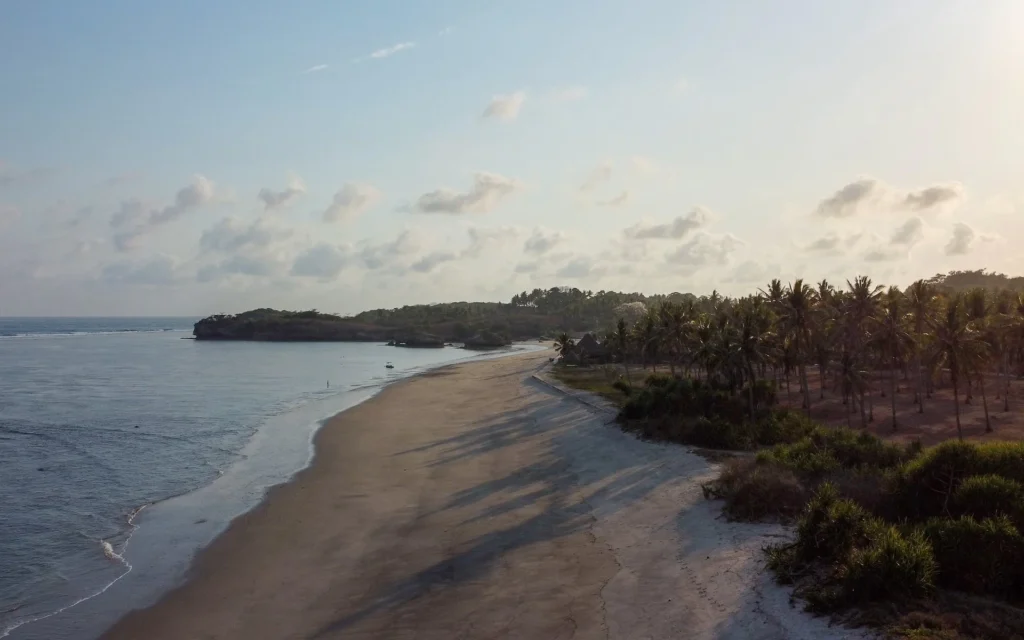
Kerewe Beach (locally known as Pantai Kerewei) sits on the south-west coast of Sumba Island, within West Sumba Regency. It is part of the Lamboya district, approximately 70 kilometres south of Tambolaka Airport (TMC), which is the main entry point into West Sumba.
To get there, most travellers fly from Bali to Tambolaka and arrange a private transfer from the airport. The drive south takes between 1.5 and 2.5 hours depending on road conditions. There is no reliable public transport on this route, so a private vehicle or driver is the standard approach. Sumba Retreat can arrange transfers for guests directly.
The surrounding landscape on the drive down is one of the first things that signals you are somewhere genuinely different. Sumba’s south-west coast is savanna country: rolling golden hills, open grassland, distant limestone cliffs, and the occasional buffalo or horse wandering across the road. It looks nothing like Bali, Lombok, or the Mentawais. By the time you arrive at the beach and see the coconut palms lining the shore, you already know this trip is going to be memorable.
The Wave at Kerewe Point: A Technical Breakdown
Kerewe Point is a right-hand point break that peels across a coral reef shelf on the southern end of the beach. Understanding the mechanics of the wave before you paddle out will help you get into position quickly and make the most of each session.
Wave direction and shape
The wave breaks from left to right when viewed from the beach, meaning it is a right-hander for regular-footed surfers (left foot forward). Goofy-footed surfers (right foot forward) will be riding backhand, which is still very much doable but requires a different approach in the barrel sections.
The shape of the wave is what makes Kerewe special. Rather than closing out suddenly across the whole width of the break, the wave peels progressively down the line. This gives surfers time to generate speed, set up for turns, and in the right conditions, find a short but punchy tube section in the mid-part of the wave. On solid swell days, rides of 60 to 100 metres are achievable from the top of the point to the channel exit.
Reef bottom and water depth
The reef at Kerewe is predominantly live coral at a depth that becomes notably shallow on low tide. This is the most important safety consideration at the break. At mid to high tide, the water over the reef is deep enough to fall into without significant risk of impact. At low tide, the reef becomes shallow enough to be dangerous on a wipeout, particularly in the more critical sections near the peak.
The standard approach is to surf Kerewe on a rising or full tide and to avoid the peak sections at low water. The channel on the northern side of the break provides a safe paddle-out route regardless of tide, and exiting via the channel after a ride is always the better option compared to walking across the reef.
Wave size range
Kerewe handles a wide range of swell sizes, which is one reason it suits multiple skill levels at different times of the season.
- 0.5 to 1 metre (waist to shoulder high): Mellow, forgiving, good for beginners who are past the pop-up stage and comfortable paddling through a gentle channel. Also excellent for longboarding.
- 1 to 1.5 metres (shoulder to overhead): The sweet spot for intermediate surfers. The wave has enough face to work with, the peel is consistent, and there is enough power to drive turns without the break becoming heavy or dangerous.
- 1.5 to 2.5 metres (overhead to double overhead): Advanced territory. At this size the wave becomes fast, the reef sections get shallower relative to the swell height, and positioning in the lineup requires solid experience. The wave quality at this size can be genuinely exceptional, but it demands respect.
- Above 2.5 metres: Expert only. At this size Kerewe produces powerful, consequence-heavy surf. Only surfers with significant reef break experience should consider paddling out in these conditions.
When to Surf Kerewe Beach: Seasonal Conditions
April to June: The opening of the season
April marks the beginning of meaningful swell at Kerewe. Groundswells generated in the Southern Ocean start arriving at the south-west coast of Sumba with increasing regularity as the dry season gets underway. Wave size during April and May tends to sit in the 0.8 to 1.5 metre range, which is ideal for intermediate surfers and confident beginners.
The wind is one of the real advantages of surfing Kerewe in the early season. Light offshore winds in the mornings, coming from the north-east, groom the surface of the wave into clean, glassy conditions. These morning sessions in April, May and June are among the best the break offers all year in terms of sheer aesthetics. The sun rises behind the hills inland, the wind holds offshore, and the wave peels without a ripple on its face.
Visitor numbers in April and May are lower than the peak months, so if you are looking for an uncrowded experience (and Kerewe is already among the least crowded surf spots in Indonesia), these months deliver that in abundance.
July and August: Peak swell season
July and August are the months when the Southern Ocean sends its most powerful and consistent swells into Sumba’s south-west coast. Groundswell periods of 14 to 18 seconds are common during these months, which means the wave at Kerewe has significantly more power and push than the shorter-period wind swells of the shoulder months.
For advanced and expert surfers, July and August are the prime targeting window. Swell heights regularly reach the 1.5 to 2.5 metre range, and on bigger pulse days the wave produces the kind of sections that reward committed, experienced surfing. These are also the months when Nihiwatu further up the coast tends to be at its best, making it practical to combine a stay at Sumba Retreat with a surf charter excursion to that break.
One consideration for July and August is that afternoon winds tend to be stronger and more variable during peak season. The morning window remains excellent, but conditions can deteriorate more quickly by mid-morning compared to the shoulder months. Being in the water at sunrise pays off significantly during this period.
September and October: Shoulder season
September is arguably the most underappreciated month to surf Kerewe. Swell is still arriving from the Southern Ocean but has started to moderate from the peak intensity of July and August. Wave size sits comfortably in the 1 to 1.5 metre range for most of the month, winds remain reliable in the morning, and visitor numbers drop as international travellers return home from their northern summer holidays.
For intermediate surfers who want quality waves without the occasional intimidation of the bigger July swells, September is the ideal month. The warmth is consistent, the evenings are long, and the retreat tends to have a relaxed, communal atmosphere.
October becomes hit and miss as the season transitions toward the wet. Good swells still arrive but with less consistency. Some weeks are flat. The month suits surfers who are flexible and happy to combine surfing days with land-based exploration of Sumba when the surf is down.
November to March: Off-season
The wet season brings onshore winds and inconsistent, often poor surf conditions to the south-west coast. Kerewe Beach is not well-suited to surfing during these months. Swell from the Southern Ocean drops significantly, and the predominant south-west winds blow directly onshore, making conditions messy and unrewarding.
Travellers who visit Sumba in the wet season do so for reasons other than surfing, principally to experience the Pasola festival (which takes place between January and March depending on the moon calendar) and to explore the island’s cultural and natural attractions with fewer other tourists around.
How Kerewe Beach Compares to Other Sumba Surf Spots
Sumba has a number of surf spots along its south and south-west coastline, and understanding how Kerewe fits into that landscape helps with trip planning.
Kerewe vs. Nihiwatu
Nihiwatu (the wave associated with Nihi Sumba Resort) is the most internationally famous surf spot in Sumba. It is a world-class left-hand reef break with long, powerful barrels on the right swell, and access is controlled through a surf charter system managed by the resort.
Kerewe and Nihiwatu are different waves for different contexts. Nihiwatu is a left, Kerewe is a right. Nihiwatu is more powerful and hollow on its best days. Kerewe is more accessible across a wider range of skill levels and is available without a charter fee. For most visiting surfers, Kerewe provides better daily surfing value, while Nihiwatu is worth adding to the itinerary as a special occasion for those with advanced skills and the appropriate budget.
The two breaks can also be surfed in combination. Kerewe Point for morning sessions most days, with occasional surf charter days to Nihiwatu for variety. Staying at Sumba Retreat gives you the best possible base for this approach, since you are already positioned on one of the best breaks on the coast.
Kerewe vs. Marosi
Marosi Beach is roughly 30 kilometres north-west of Kerewe along the coast road. It is a beach break with a reef section at its southern end, more exposed than Kerewe and picking up swell from a slightly different angle. Marosi is worth visiting as a day trip, particularly on days when the swell direction favours it over Kerewe. But it does not have accommodation directly on the beach and requires transport from wherever you are staying.
For a surf trip centred on one location, Kerewe is the more practical choice. For surfers who want to explore, Marosi adds good variety to a week-long itinerary.
Kerewe vs. Tarimbang
Tarimbang is a long right-hand point break on the south-east coast, wrapping around a headland into a sheltered bay. On its best days it offers some of the longest rides in Sumba. The trade-off is the distance: getting from the west coast to Tarimbang involves a significant inland drive that adds a full day to any itinerary.
For surfers on a 10 to 14-day trip to Sumba, a Tarimbang excursion is a worthwhile addition and can be combined with exploring the different landscape and culture of East Sumba. For a 7-day trip, Kerewe and its nearby breaks provide enough variety to fill the week without the logistical overhead of crossing the island.
Preparing for Your First Session at Kerewe
Equipment checklist
Before paddling out at Kerewe for the first time, make sure you have the following:
- Reef booties (2mm): Non-negotiable for comfort and safety on the coral reef. Thin booties allow you to feel the board while protecting your feet from cuts and abrasions.
- Leash in good condition: Check your leash cord and the connection at the board before every session. A broken leash at a reef break is a significant safety issue.
- Reef-safe sunscreen: Sumba’s marine environment is protected and the ecosystem at Kerewe is healthy coral. Standard chemical sunscreens harm coral reefs. Use a mineral-based, reef-safe option.
- Adequate hydration: Surfing in tropical heat is physically demanding. Drink water before and after each session and avoid surfing for extended periods without a break during the hottest part of the day.
- First aid basics at the retreat: The team at Sumba Retreat can help with minor reef cuts and abrasions. Carry antiseptic that is appropriate for coral cuts in your personal kit.
Reading the break before paddling out
Spend 10 to 15 minutes on the beach before your first session at Kerewe. Watch where the wave breaks, where it peels to, and where the channel is. Identify the deepest water for paddling out and the safest line for exiting after a ride. Notice where other surfers are sitting in the lineup and what section of the wave they are catching.
This observation time is especially valuable on your first day at a new break. Kerewe has a relatively readable pattern but the peak moves with the tide, and knowing this before you are in the water makes your session significantly more efficient and enjoyable.
Lineup etiquette at Kerewe
One of the great pleasures of surfing Kerewe is that the lineup is small. On most days you will be surfing with the other guests at Sumba Retreat and occasionally a local surfer or two from the surrounding area. The atmosphere is relaxed and cooperative rather than competitive.
Standard surf etiquette applies: the surfer closest to the peak has priority, do not drop in on someone already riding, communicate clearly when you are going for a wave, and let the wave count balance itself naturally over a session. With a small group and a consistent peel, there are enough waves for everyone.
Staying at Sumba Retreat Kerewe: The Direct Beach Access Advantage
Most surf destinations in Indonesia involve some version of the same logistics: you stay somewhere in a town or village, you check a surf report or ask at a local board rental shop, you get transport to the break, you surf, and then you travel back. That system works, but it adds friction to every part of the day.
At Sumba Retreat Kerewe, the entire equation changes. The accommodation is built directly on Kerewe Beach, in the coconut palms above the high tide line, with a clear view of the break from the bungalow verandas. When you wake up in the morning, you look at the surf. When conditions are right, you are in the water within minutes. When you come in from a session, your room is 50 metres away.
That direct access has practical consequences that compound over the course of a week-long trip. You surf more sessions because the barrier to entry is zero. You catch the best morning windows reliably because there is no commute involved. You can paddle back out for an afternoon session on a whim rather than committing to a full day at the beach. And when you are tired, you stop. The flexibility is total.
The retreat itself is built in traditional Sumbanese style, with thatched roof bungalows and villas that use local bamboo and eco-friendly materials. The aesthetic is deliberately rooted in the local environment rather than imported from a generic resort template. The menu features local produce. The team is from the surrounding community. The approach is to sit lightly on the landscape rather than dominate it.
For surfers who care about where their travel budget goes and what kind of footprint their trip leaves, this matters. Sumba is still a destination in early development in terms of tourism. The choices that visitors and operators make now will shape what the island looks and feels like in 10 years. Staying at a small, locally grounded eco retreat is one way to contribute to a version of Sumba’s tourism future that preserves what makes the island worth visiting.
Other Things to Do at Kerewe Beach When You Are Not Surfing
Even on a surf-focused trip, there will be flat days, big days where the surf is beyond your level, or afternoons when you are simply ready to do something different. Kerewe Beach and the surrounding area offer enough to fill those hours well.
Snorkelling: The reef at Kerewe is healthy and the water clarity is excellent on calm days. Snorkelling directly from the beach gives access to coral formations and marine life within a short swim of shore.
Beach walks: The coastline in both directions from Kerewe is largely undeveloped. Walking along the beach at low tide in either direction takes you through stretches of shore that feel genuinely remote.
Village visits: The local community around Kerewe Beach belongs to the Lamboya district of West Sumba. The surrounding villages maintain traditional Sumbanese architecture and customs. Respectful visits, ideally arranged with local guidance, offer genuine insight into daily life and culture.
Motorcycling inland: The roads inland from the coast lead through savanna landscape that is unlike anywhere else in Indonesia. Renting a motorcycle for a half-day ride through the hills gives you a completely different perspective on Sumba beyond the coastline.
Watching the sunset: Kerewe faces roughly south-west, which means the sun sets over the water and the horizon from the beach. On a clear evening, watching the sunset from the shore after a day in the water is one of those simple travel moments that sticks.
Ready to Book Your Kerewe Surf Trip?
Kerewe Beach is not going to stay undiscovered forever. The infrastructure in West Sumba is improving, travel writers are starting to pay attention, and the surfers who have already been there tend to tell other surfers. The window to experience Kerewe Point with small lineups and a genuine sense of discovery is still open, but it will not be open indefinitely.
If you are planning a surf trip to Indonesia and want something that goes beyond the over-crowded breaks of Bali without requiring a liveaboard budget or expert-only conditions, Kerewe is the answer.
Check availability at Sumba Retreat Kerewe and book your stay directly on the beach. The waves are right out front.
For surf conditions, accommodation enquiries and transfer arrangements from Tambolaka Airport, contact Sumba Retreat on WhatsApp at +62 853 3923 4685 or email info@sumbaretreat.com.