
There are cultural experiences in Indonesia that are genuinely unforgettable, and then there is Pasola Lamboya. A mounted spear-jousting ritual carried out on horseback by two opposing groups of warriors in traditional dress, watched by thousands of local spectators in the fields of West Sumba, it is one of the most extraordinary things you can witness anywhere in Southeast Asia. It is not a performance. It is not staged for tourists. It is a living sacred ceremony that has been taking place in the Lamboya district of West Sumba for centuries, and it remains as real, as intense, and as culturally significant today as it has ever been.
This guide covers everything you need to know about Pasola Lamboya: what it is, where it comes from, what the ritual sequence looks like from start to finish, when it happens and how to plan around the unpredictable dates, how to attend as a respectful visitor, and why staying in the Lamboya district at Sumba Retreat Kerewe puts you closer to this ceremony than any other accommodation on the island.
What Is Pasola?
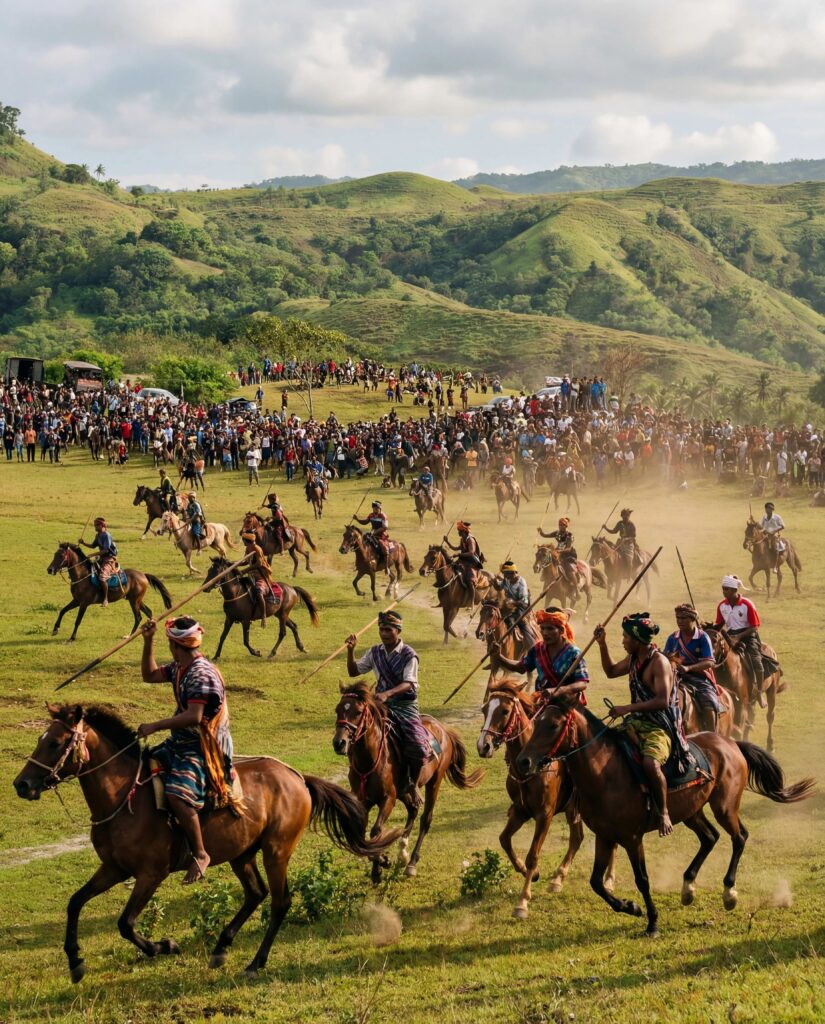
Pasola is a traditional ritual ceremony held annually in West and Southwest Sumba, involving mounted horsemen from two opposing groups who charge at each other across an open field, throwing long wooden spears at their opponents. The word Pasola itself derives from the Sumbanese word sola or hola, which refers to the wooden spear used in the ritual. Translated directly, Pasola means spear-throwing, but the name captures only the physical element of what is in practice a deeply spiritual and socially complex ceremony.
Pasola is held in four districts of West and Southwest Sumba: Lamboya, Kodi, Wanokaka, and Gaura. Each district holds its own Pasola at a different time within the February to March window, determined independently by the Rato of each community. Lamboya is typically the first of the four to hold its Pasola each year, usually in February, making it the opening ceremony of the annual Pasola season across the region.
The ceremony is rooted in the Marapu belief system, the indigenous animist spiritual tradition of the Sumbanese people. Pasola is not a sport, and it is not entertainment. It is an act of communication between the living community and the ancestral spirits who, in the Marapu worldview, influence everything from the quality of the harvest to the health of the community and the fertility of the land. Understanding this context is the single most important thing a visitor can bring to witnessing Pasola.
The Marapu Connection: Why Pasola Exists
To understand why Pasola takes the form it does, you need to understand something of the Marapu belief system that gives it meaning.
Marapu is the indigenous spiritual tradition of Sumba, predating both the arrival of Christianity and Islam on the island. At its core, Marapu holds that the world of the living exists in a relationship of ongoing exchange with the world of the ancestral spirits. The ancestors are not gone: they are present, attentive, and responsive to the behaviour and rituals of the living. When the community conducts its ceremonies correctly, with the right offerings, the right prayers, and the right spiritual discipline, the ancestors are pleased. When they are pleased, the crops grow well, the rains come at the right time, the sea provides fish, and the community prospers.
Pasola sits at the intersection of this spiritual economy and the agricultural calendar. It takes place at the moment when the planting season is about to begin, which is one of the most significant transitions in the year for an agricultural community. The ritual is an act of petition to the ancestors and to the gods: a demonstration of the community’s strength, its cohesion, and its willingness to offer something of value (including, in the traditional form, the possibility of blood) in exchange for a bountiful harvest.
The Rato, the traditional spiritual leader and priest of the Sumbanese clan system, is the figure who oversees the entire ritual. It is the Rato who reads the signs in nature that determine when Pasola can take place, who leads the prayers that open the ceremony, and who throws the first symbolic spear that signals the beginning of the jousting. Without the Rato’s authority and blessing, there is no Pasola.
The Origin Story of Pasola
The mythological origin of Pasola varies in its details across different tellings, but the central narrative is consistent across most Sumbanese oral traditions.
Long ago, a nobleman named Ubu Dula left his village and his wife, Rabu Kaba, to travel to a distant place. After waiting for a very long time without word from her husband, Rabu Kaba eventually accepted that he was not returning and married another man. When Ubu Dula finally came back and found his wife remarried, he was filled with grief and rage. The conflict that followed between his supporters and the new husband’s clan was a source of deep communal trauma and imbalance.
The Rato recognised that this unresolved conflict between the clans created a spiritual imbalance that needed to be addressed and channelled. Rather than allowing the conflict to destroy the community through actual warfare, the ritual of Pasola was instituted as a way to express the tension between opposing groups in a formalised, spiritually sanctioned context that transformed destructive energy into something regenerative. The blood that falls on the field during Pasola is not a tragedy: in the Marapu worldview, it is a sacred offering that feeds the earth and restores the balance between the human and spiritual worlds.
This origin story explains why Pasola involves two opposing groups rather than a single communal celebration, and why the element of physical risk has always been central to its meaning. Pasola without the possibility of injury would not be Pasola: it would be theatre.
The Nyale Ritual: What Comes Before Pasola
Pasola cannot begin until the Nyale ritual has taken place. Understanding Nyale is essential for understanding why Pasola dates cannot be fixed in advance on a calendar and why the window of several weeks around the February full moon must be treated with flexibility by any visitor hoping to witness the ceremony.
What are Nyale?
Nyale are sea worms, polychaete worms that live in the crevices of coral reefs and emerge in massive numbers to spawn at the ocean’s surface at specific times of the lunar cycle. Their appearance is triggered by a combination of water temperature, moon phase, and the transition of seasons, and it occurs with remarkable consistency in the same general period each year around the south coast of Sumba.
In the Marapu belief system, the Nyale worms are not simply a natural phenomenon. They are understood as manifestations of ancestral spirits, or in some tellings as the transformed body of Nyi Loro Kidul, a powerful goddess figure associated with the sea and with fertility. Their appearance is read as a sign from the spirit world: when the Nyale appear in abundance, the ancestors are signalling their approval and the community may proceed with Pasola. When they do not appear, or appear in small numbers, it is a message that the community must wait, reflect, or conduct additional ceremonies before proceeding.
The Nyale hunting ceremony
On the night determined by the Rato to be the correct night for the Nyale to appear, the entire community gathers at the beach in the hours before dawn. The Rato leads the group in prayers and offerings at the water’s edge, calling the Nyale and the ancestral spirits to reveal themselves. When the tide and conditions are right, the worms emerge at the surface of the water in the shallows and are gathered by hand.
The appearance and quality of the Nyale is then examined carefully by the Rato. Healthy, numerous Nyale in a variety of colours are an excellent omen: they indicate that the harvest will be abundant and that Pasola may proceed. The specific colour combinations and the density of the Nyale are read as messages with nuanced meaning that only the Rato is trained to interpret.
The Nyale are also eaten. Consumed raw or cooked, they are a delicacy that is eaten in the belief that consuming them transfers the fertility and spiritual energy they carry into the bodies of those who eat them. The Nyale hunting night is a communal celebration as much as a ritual: the beach fills with people, the mood is a mix of reverence and festivity, and the night has a quality of anticipation and shared identity that is deeply affecting even for visitors who are encountering it for the first time.
For visitors planning to attend Pasola Lamboya, arriving in time for the Nyale ritual adds an entirely different dimension to the experience. The ceremony on the beach the night before Pasola is in some ways as memorable as the jousting itself.
Pajura: The Boxing Ritual Before Pasola
In some Lamboya traditions, a ceremony called Pajura takes place in the days before the main Pasola. Pajura is a ritual boxing match in which participants wrap their fists with traditional cloth and fight in a formalised context. Like Pasola itself, Pajura is understood as a way of channelling physical and spiritual energy in a controlled ritual form, and the blood or bruises that result are seen as part of the offering being made to the ancestral spirits.
Pajura is not universally practised across all four Pasola districts and its place in the ceremonial sequence varies by community. In Lamboya, where ceremonial traditions are among the most intact of the four Pasola regions, Pajura is part of the full ritual sequence that leads up to the main Pasola day.
The Day of Pasola Lamboya: What Happens
The Pasola field in Lamboya is a flat, open area of land where the two opposing groups face each other across the width of the ground. By the morning of the ceremony, the field is surrounded by thousands of spectators: local Sumbanese families who have travelled from surrounding villages and the wider district to be present, government officials, and an increasing number of visitors from other parts of Indonesia and internationally.
The horsemen and their preparation
The riders who participate in Pasola are selected men from the opposing groups, typically numbering around 25 to 50 per side though this varies. They ride bareback, without saddles, in a demonstration of horsemanship that reflects years of practice and a relationship with their horses that is entirely different from recreational riding. The Sumbanese horse is a specific local breed, small and powerful, trained for the fast, manoeuvring work that Pasola demands.
Both the riders and their horses are dressed in traditional ceremonial clothing for Pasola. The riders wear ikat textiles, headbands, and traditional ornaments. The horses are decorated with woven cloth, bells, and ornamental pieces that make them as visually striking as their riders. The preparation of horses and riders before the ceremony begins is itself worth witnessing: the combination of colour, ritual care, and the contained energy of horses and men about to enter the field has an atmosphere unlike anything else.
The spears used in Pasola today are blunted wooden shafts approximately 1.5 metres long. In the historical form of the ceremony, sharp spears were used, and deaths occasionally occurred. The transition to blunted spears came gradually as the ceremony evolved and as outside authorities (first colonial, then Indonesian government) exerted pressure to reduce fatalities. However, even with blunted spears, Pasola remains physically dangerous. Riders are thrown. Impacts at the speeds involved cause real injury. The possibility of harm is not symbolic: it is present, and it is part of what gives the ceremony its spiritual legitimacy.
The opening prayer and the Rato’s first throw
The Pasola itself begins only after the Rato has led the assembly in prayers addressed to the ancestral spirits, requesting their blessing for the ceremony and for the planting season that follows. The prayers are conducted in the ritual language of the Marapu tradition, and the solemnity of this opening sequence stands in contrast to the noise and movement of the crowd around it.
When the prayers are complete, the Rato throws his own spear symbolically between the two assembled groups. This throw is the signal that the ceremony may begin. The moment the Rato’s spear crosses the field, the atmosphere transforms instantly: the horsemen charge, the crowd erupts, and the Pasola is underway.
The jousting sequence
Once the ceremony begins, the two groups of horsemen charge at each other repeatedly across the field. Riders throw their spears at opponents at high speed, attempting to strike while simultaneously avoiding incoming throws. The skill involved is extraordinary: controlling a bareback horse at full gallop, identifying a target, timing a throw, and deflecting or avoiding incoming spears requires a combination of horsemanship, athleticism, and tactical awareness that takes years to develop.
The jousting continues in multiple rounds across the morning and into the early afternoon. There are no formal winners and no scoreboard. The ritual is not a competition in the sporting sense: it is a performance of communal strength and an offering of energy and blood to the ancestral spirits. If a rider is struck and bleeds, the blood falling on the ground of the field is the most direct form of the offering that Pasola is designed to make.
The field fills with the sound of hooves, the crack of spear against flesh or air, the shouts of the crowd, and occasionally the eruption of spontaneous celebration when a particularly skilled throw or ride catches the attention of the spectators. The sensory intensity of Pasola, particularly for visitors who have never witnessed anything like it, is almost overwhelming.
When Does Pasola Lamboya Happen?
This is the question that causes the most logistical difficulty for visitors planning a trip around Pasola, and it requires an honest answer rather than a convenient one.
Pasola Lamboya takes place in February each year, typically in the first two weeks of the month. The exact date is determined by the Rato based on the appearance of the Nyale worms, which in turn is governed by the lunar cycle: the Nyale appear approximately six to fourteen days after the full moon in the month that the Rato determines to be correct. In recent years, under increasing pressure from both tourism operators and regional government who want to give visitors advance notice, some Pasola dates have been announced further in advance than the traditional one to two week window. However, it is still not possible to give a fixed calendar date that is guaranteed months ahead of time.
The practical implication for visitors is to plan for flexibility. A minimum of seven to ten days in Sumba around the February window is strongly recommended for anyone specifically hoping to witness Pasola Lamboya. Arriving with a fixed two-day window and expecting to hit the ceremony is possible but involves an element of luck. Arriving with a week or more of flexibility, based in the Lamboya district where the ceremony will occur, and staying in contact with local guides and the retreat team for updates on the Rato’s announcement is the right approach.
In some years, provisional dates for the Pasola season are announced by regional tourism authorities in December or January. These are indicative rather than confirmed and are subject to the Rato’s final determination, but they provide a useful planning anchor. Following Explore Sumba and other local tourism organisations on social media is one of the most reliable ways to get early notice of provisional dates.
Pasola Lamboya vs. the Other Pasola Ceremonies
With four Pasola ceremonies across the region, visitors who have the time and flexibility can in principle attend more than one. Understanding the sequence and character of each helps with planning.
Lamboya: Usually the first Pasola of the season, in February. Lamboya is in the same district as Kerewe Beach, making it directly accessible from Sumba Retreat without a long drive. The Lamboya ceremony takes place in the fields of the Lamboya district, a short distance from the coast. The proximity and the local community context make this the most naturally integrated Pasola experience for guests staying at the retreat.
Kodi: The Kodi Pasola, based around the village of Wainyapu in the Kodi region of Southwest Sumba, is often considered the most dramatic of the four ceremonies in terms of scale and the intensity of the spear-throwing. It takes place around the same February period as Lamboya, sometimes on a different day, sometimes overlapping. Kodi is approximately 2 to 3 hours from Kerewe Beach by road.
Wanokaka: The Wanokaka Pasola takes place in March, after the Lamboya and Kodi ceremonies. Wanokaka is in the hills above the south coast of West Sumba and the field where the ceremony takes place has a dramatic landscape backdrop. For visitors who have the time to attend a second Pasola after witnessing Lamboya, Wanokaka in March is worth the additional stay.
Gaura: The Gaura Pasola also falls in the February to March window. It is the least visited of the four by international tourists and retains perhaps the most unmediated character of the four ceremonies as a result.
How to Attend Pasola Lamboya as a Visitor
Pasola is open to visitors and the community genuinely welcomes outside witnesses to the ceremony, provided those visitors conduct themselves with appropriate respect. A few practical and cultural guidelines make the difference between an experience that enriches everyone and one that intrudes.
Hire a local guide
Attending Pasola without a local guide is possible but significantly poorer as an experience. A good local guide provides the ritual context that makes sense of what you are watching, navigates the logistics of where to stand, when to move, and how to respond to crowd dynamics, communicates with community members on your behalf, and gives you access to the nuanced storytelling that turns a visually extraordinary spectacle into a genuinely understood cultural encounter.
The team at Sumba Retreat can connect guests with trusted local guides who have experience accompanying visitors to Pasola Lamboya. This is one of the most direct advantages of staying in the Lamboya district: the guides who know Pasola Lamboya best are local to this area, and the retreat has relationships with the people who provide this kind of contextual support.
Dress appropriately
Pasola is a sacred ceremony taking place on land with spiritual significance. Dress modestly: covered shoulders, covered knees. Avoid clothing with provocative graphics or messaging. The Sumbanese community has absorbed an increasing number of international visitors over recent years and is generally tolerant of the cultural differences that visitors bring, but dressing with obvious respect signals that you understand you are a guest at something important.
Positioning and safety
The field where Pasola takes place is surrounded by spectators, but not all positions are equally safe. Horsemen charge at speed and spears are thrown with force. Spectators who stand too close to the field are within range of an errant throw or a horse that runs past the edge of the jousting area. Follow the lead of your guide for where to stand, and move when you are asked to move. The local community has a well-developed understanding of the safe zones around the field, and your guide will keep you within them.
Photography is generally accepted but pointing a camera directly into the face of a participant or a Rato during prayer is disrespectful. Ask your guide about what is appropriate before the ceremony begins rather than making individual judgements in the moment.
Stay for the full sequence
Visitors who arrive for the main jousting and leave before the ceremony concludes miss the quieter, more intimate moments that often carry the most meaning: the Rato’s closing prayers, the post-ceremony gathering of families, the interaction between riders and community members after the field clears. Allow a full day for Pasola Lamboya rather than treating it as a two-hour highlight.
Why Lamboya Is the Right Place to Base Your Pasola Trip
Sumba Retreat Kerewe sits within the Lamboya district, the same administrative and cultural territory where Pasola Lamboya takes place. This geographic proximity is not a coincidence or a marketing point: it is a genuine practical and experiential advantage for visitors who come to Sumba specifically to witness the ceremony.
Staying in Lamboya means that when the Rato announces the date of Pasola, you are already there. There is no overnight journey from another part of the island. There is no scramble for accommodation in an unfamiliar area. You are part of the community’s daily life in the days leading up to the ceremony: you see the preparations, you feel the anticipation that builds in the village, and you have the time to connect with local people and understand the context before the main day arrives.
The retreat team at Sumba Retreat maintains close relationships with the local community in Lamboya and will keep guests informed as announcements about the Pasola date develop. They can facilitate guide arrangements, advise on the Nyale ceremony timing if it falls during your stay, and give you the kind of on-the-ground, up-to-date information that no travel website can provide.
The surf season does not overlap with the Pasola window (Pasola is in February, the surf season runs April to October), but for travellers whose primary motivation is cultural rather than surf-focused, the Lamboya district in February offers one of the most extraordinary and authentic travel experiences available anywhere in Indonesia.
Practical Checklist for Attending Pasola Lamboya
- Plan for 7 to 10 days in Sumba around the February full moon. Do not plan a 2-day trip specifically for Pasola. Flexibility is not optional.
- Stay in the Lamboya district. Proximity to where the ceremony takes place is the most important logistical decision you can make.
- Confirm with local sources close to your travel dates. Regional tourism organisations and the retreat team will have the most current information on the Rato’s announcement.
- Arrange a local guide in advance. Do not try to arrange a guide on the day of the ceremony when everyone else is also looking.
- Attend the Nyale ritual if possible. The beach ceremony the night before Pasola is part of the full experience.
- Dress modestly and behave respectfully. You are a guest at a sacred ceremony.
- Bring cash. The field area has food vendors and small stalls. ATM access near the ceremony site is not reliable.
- Bring water and sun protection. The ceremony takes place in an open field during the day. The February sun in Sumba is intense.
- Bring a camera with a long lens if possible. The action happens across the width of the field and a telephoto lens makes a significant difference to what you can capture without encroaching on the ceremony itself.
Experience Pasola Lamboya from the Right Base
Pasola Lamboya is one of the most extraordinary cultural experiences available anywhere in Indonesia. It is sacred, physically intense, visually overwhelming, and deeply human in the way it connects a living community to its ancestors, its land, and its own history. No travel article fully captures what it feels like to stand at the edge of the field when the horsemen charge.
What a travel article can do is point you toward the best possible base from which to experience it. Book your stay at Sumba Retreat Kerewe, located in the heart of the Lamboya district, for a February visit that puts you directly inside the community where Pasola Lamboya takes place.
Contact the team on WhatsApp at +62 853 3923 4685 or email info@sumbaretreat.com to discuss timing, guide arrangements, and what to expect during your Pasola visit. For logistics on getting to Lamboya from Bali, read the full Sumba travel logistics guide. For everything else the island offers beyond the ceremony, the Sumba Island Travel Guide covers the full picture.
Sumba Retreat Kerewe is located on Kerewe Beach (Pantai Kerewei) in the Lamboya district, West Sumba, East Nusa Tenggara, Indonesia. The Pasola Lamboya ceremony takes place annually in February within the same district.