Sumba is the kind of island that makes travellers wonder why they waited so long to come. It is dramatic, beautiful, culturally rich, and still genuinely off the tourist trail in ways that matter: empty beaches, uncrowded surf, traditional villages where ancient customs are practised without any performance for visitors, and landscapes that look unlike anything else in Indonesia.
It is also, if we are being honest, not the easiest island to plan a trip to. Information is scattered, logistics require more advance thought than a trip to Bali, and the gap between arriving prepared and arriving unprepared makes a significant difference to the quality of your experience.
This guide exists to close that gap. Whether you are a first-time visitor to Sumba or returning after years of meaning to go back, everything you need to plan a well-organised and genuinely rewarding trip is collected here: when to visit, how to get there, which part of the island to prioritise, what to do and see, where to eat, and where to stay. By the end of this page, you will have a clear picture of what Sumba is, what makes it worth the journey, and exactly how to make the most of your time there.
What Is Sumba Island?
Sumba is a large island in the province of East Nusa Tenggara, in the eastern part of the Indonesian archipelago. It covers approximately 11,000 square kilometres and has a population of around 800,000 people spread across four administrative regencies: West Sumba, Southwest Sumba, Central Sumba, and East Sumba.
Geographically, Sumba sits south of Sumbawa and Flores, separated from its neighbours by open stretches of sea. It faces the Indian Ocean on its southern coast, which means it receives direct groundswell from the Southern Ocean during the dry season, making it one of the better surf destinations in Eastern Indonesia. The northern coast faces the Sumba Strait toward Flores and Sumbawa.
The island’s landscape is one of its most striking qualities. Unlike the lush, volcanic green of Bali or Lombok, much of Sumba is savanna: rolling grassland, open hills covered in dry-season gold, limestone outcrops, and scattered forest. The south coast has dramatic cliffs and long white-sand beaches. The interior is agricultural land, traditional villages, and the occasional waterfall hidden in the folds of the hills. It is beautiful in a way that feels unfamiliar to travellers used to the tropical rainforest aesthetic of western Indonesia.
Culturally, Sumba is also distinct. The Marapu animist belief system has deep roots on the island and still informs the spiritual life of many Sumbanese communities, even alongside Christianity (the majority religion by formal affiliation) and Islam (practised by a smaller portion of the population). The megalithic tomb tradition, the ikat weaving culture, the Pasola ritual festival, and the hierarchical clan structure of traditional Sumbanese society give the island a cultural texture that is unlike anywhere else in Indonesia.
Sumba vs. Bali vs. Lombok: Why Sumba Is Different
Most visitors to Indonesia start with Bali, and many never leave. Bali is genuinely extraordinary and deserves its reputation, but it is also heavily visited, increasingly expensive in the areas that matter to travellers, and struggling with the infrastructure pressures of millions of annual tourists.
Lombok sits a step behind Bali in development terms, with the Gili Islands driving most of the international visitor traffic and the south coast increasingly following Bali’s resort development pattern.
Sumba is in a different position entirely. The number of international visitors per year remains small relative to these western neighbours. There is no tourist strip. There are no traffic jams on the way to the beach. There are no waves with 50 surfers in the lineup. What Sumba offers is the version of Indonesian island travel that most travellers imagine when they decide to come to Indonesia and that Bali can no longer reliably deliver: space, beauty, authenticity, and the genuine sense that you are somewhere that has not yet been fully discovered.
The trade-off is real. Infrastructure in Sumba is less developed than in Bali. Transport options are more limited. The range of restaurants, cafes, and services available to international visitors is smaller. Planning a trip requires more research and more advance preparation. But for travellers who value the quality of the experience over the convenience of the logistics, Sumba consistently delivers.
When to Visit Sumba
The dry season: April to October
The dry season is the primary travel window for most visitors to Sumba, and for good reason. Between April and October, rainfall is minimal, roads are at their most reliable, and the combination of consistent sunshine and south-east trade winds creates the conditions that make the island at its most accessible and visually spectacular.
The dry season is also the surf season. South and south-west groundswell from the Indian Ocean arrives at the south coast of Sumba with consistency during these months, making the surf breaks on the south and south-west coast productive from April through October. For surfers, June through September represents the core of the season, with July and August typically producing the most powerful and consistent swell.
Temperatures during the dry season are warm but not oppressive. The south-east trade winds keep the air moving, and humidity is significantly lower than in the wet season. Evenings on the south coast can be genuinely cool, particularly in July and August when the trade winds strengthen. A light layer for evening is worth packing even for a dry-season trip.
The wet season: November to March
The wet season in Sumba runs from approximately November through March, with the peak of the monsoon falling between December and February. Rainfall during these months can be heavy and sustained, making some roads impassable, reducing the accessibility of more remote areas, and bringing onshore winds to the south coast that make surf conditions generally poor.
However, the wet season has its own rewards for the right kind of traveller. The landscape transforms: the dry golden savanna turns vivid green, waterfalls that are reduced to a trickle in the dry season run at full volume, and the island feels more lush and alive. Visitor numbers drop significantly, which means that the small number of accommodation options available in Sumba are less likely to be fully booked and prices may be lower.
The wet season is also when the Pasola festival takes place. Pasola is one of the most extraordinary cultural events in Indonesia: a ritual mounted spear-jousting ceremony that takes place in the fields of West Sumba between January and March, with the exact dates determined by the Nyale worm ritual and the Marapu lunar calendar. For travellers with a specific interest in Sumbanese culture, timing a visit to coincide with Pasola is an experience that cannot be replicated at any other time of year. Planning around Pasola requires flexibility and advance research, as the exact dates are determined close to the event.
The shoulder months: April and October
April and October sit at the edges of the dry season and offer a particularly good combination of conditions for general travellers. Swell is present but generally moderate, making the surf accessible to a wider range of skill levels. Roads are reliable. Visitor numbers are lower than the peak July and August window. Accommodation availability is better. And the landscape in April still carries some of the green from the wet season, giving the island a lushness that the peak dry months lack.
For first-time visitors to Sumba who are not primarily motivated by chasing the biggest swells, April and October are excellent months to consider.
How to Get to Sumba
The two airports
Sumba has two commercial airports. Understanding which one to use is the first logistics decision of any Sumba trip.
Tambolaka Airport (TMC), West Sumba: This is the primary gateway for visitors heading to the south-west coast, including Kerewe Beach, Marosi, Nihiwatu and the surf breaks and cultural sites of West and Southwest Sumba. The airport is located in the north-west of the island, approximately 70 to 90 kilometres from the main destinations on the south-west coast. It handles more international-adjacent traffic than Waingapu and has better flight connections from Bali.
Waingapu Airport (WGP), East Sumba: The gateway to East Sumba, including the ikat weaving villages of the east coast, the savanna landscape of the eastern interior, and the long surf break at Tarimbang. If your itinerary is primarily focused on East Sumba, flying into Waingapu makes more sense. For most surf-focused and west coast itineraries, Tambolaka is the correct choice.
Flying from Bali to Sumba
The standard route to Sumba for international travellers is a flight from Bali’s Ngurah Rai International Airport (DPS) to either Tambolaka (TMC) or Waingapu (WGP). Flight time is approximately one hour and fifteen minutes to Tambolaka and around one hour and thirty minutes to Waingapu.
Airlines serving the Bali to Tambolaka route include Garuda Indonesia, Wings Air, and TransNusa. Flight frequency varies by season, with more options available during the dry season peak months. Booking at least three to four weeks in advance during the June to August peak is strongly recommended, as seats on these routes fill quickly during the surf season.
Flight prices are generally reasonable by international standards, though the routes are not as competitive as the main Bali to Java corridors. Checking prices across multiple booking platforms and being flexible on departure time will help you find the best available fares.
Ground transport on the island
Sumba does not have a public transport network that is practical for most international visitors. The primary options for getting around are a private driver or a self-drive rental vehicle.
Hiring a private driver for the duration of your stay is the most common approach and is strongly recommended for first-time visitors. A knowledgeable local driver provides not just transport but also guidance, translation when needed, and navigation through the parts of the island where roads are less well-marked. Your accommodation can usually recommend trusted drivers.
Self-drive rental is available in Tambolaka and Waingapu, but road conditions in parts of Sumba can be challenging, particularly after rain or on unmaintained roads to more remote areas. If you choose to self-drive, a 4WD vehicle is the sensible option.
Transfers from Tambolaka Airport to Sumba Retreat Kerewe can be arranged directly through the retreat team. The journey takes approximately 1.5 to 2.5 hours depending on road conditions.
East Sumba vs. West Sumba: Which Should You Visit?
One of the most common questions for first-time visitors to Sumba is whether to base themselves in the east or the west, or how to divide a longer trip between the two. The honest answer is that east and west offer genuinely different experiences, and the right choice depends on your priorities.
West Sumba: surf, beaches, and traditional culture
West Sumba (and the adjacent Southwest Sumba regency) is where most surf-focused visitors spend their time. The south-west coast holds the best surf breaks on the island, including Kerewe Point, Marosi, and the world-famous Nihiwatu wave at Nihi Sumba. The beaches along this coast are long, white-sand, and largely uncrowded.
West Sumba is also the heartland of traditional Sumbanese culture. The Marapu belief system has its strongest presence here. Traditional clan houses (uma), megalithic tombs in village squares, and ceremonial practices are more visible and active in West Sumba than in the more commercially developed east. The Pasola festival takes place in West Sumba.
For surfers, beach seekers, and culturally curious travellers, West Sumba is the natural base. Sumba Retreat Kerewe is located on the south-west coast of West Sumba, making it an ideal central base for exploring everything this part of the island offers.
East Sumba: ikat, savannas, and Tarimbang
East Sumba has a different character. The landscape is drier and more open, with vast savanna plains that are visually dramatic in the dry season. East Sumba is the centre of Sumba’s renowned ikat weaving tradition: the villages around Waingapu produce some of the finest traditional textiles in Indonesia, with patterns and dyeing techniques that have been passed down through generations.
Tarimbang, on the south-east coast, is a long right-hand point break that attracts dedicated surfers willing to make the cross-island journey. The east coast also has its own megalithic sites and traditional village culture, though in a form that has been somewhat more shaped by outside contact over the past century than the west.
For travellers on a 7 to 10 day trip with a primary interest in surfing and beaches, West Sumba is the natural choice and the east can be left for a return visit. For travellers on a 14-day or longer trip, combining both sides of the island provides a more complete picture of Sumba’s extraordinary diversity.
Top Experiences in Sumba
Surfing at Kerewe Point
Kerewe Point is a consistent right-hand reef break on the south-west coast that offers excellent surf for intermediate to advanced surfers during the dry season. The wave breaks in front of Sumba Retreat, meaning guests have direct beach access without any transport or logistics between accommodation and the water. For a full guide to the wave, conditions, and skill level requirements, read the Kerewe Beach Surf Guide.
Visiting Nihiwatu (Nihi Sumba)
Nihiwatu is one of the most celebrated waves in Southeast Asia and is also the centrepiece of Nihi Sumba Resort, one of the highest-rated luxury resorts in the world. Access to the wave is controlled through a surf charter system. For advanced surfers, a Nihiwatu surf charter session is worth experiencing at least once. The wave is powerful, long, and hollow on the right swell, and the controlled access means you will share it with only a small group.
Lapopu Waterfall
Lapopu Waterfall is one of Sumba’s most iconic natural attractions. Located in the hills above the south-west coast, it is a multi-tiered waterfall that drops into a series of clear freshwater pools. The hike to reach it passes through forest and farmland, and the pools at the base are clean enough to swim in. Lapopu is most dramatic in and just after the wet season when the water volume is at its peak, but it runs year-round and is worth visiting at any time of year.
Traditional Sumbanese villages
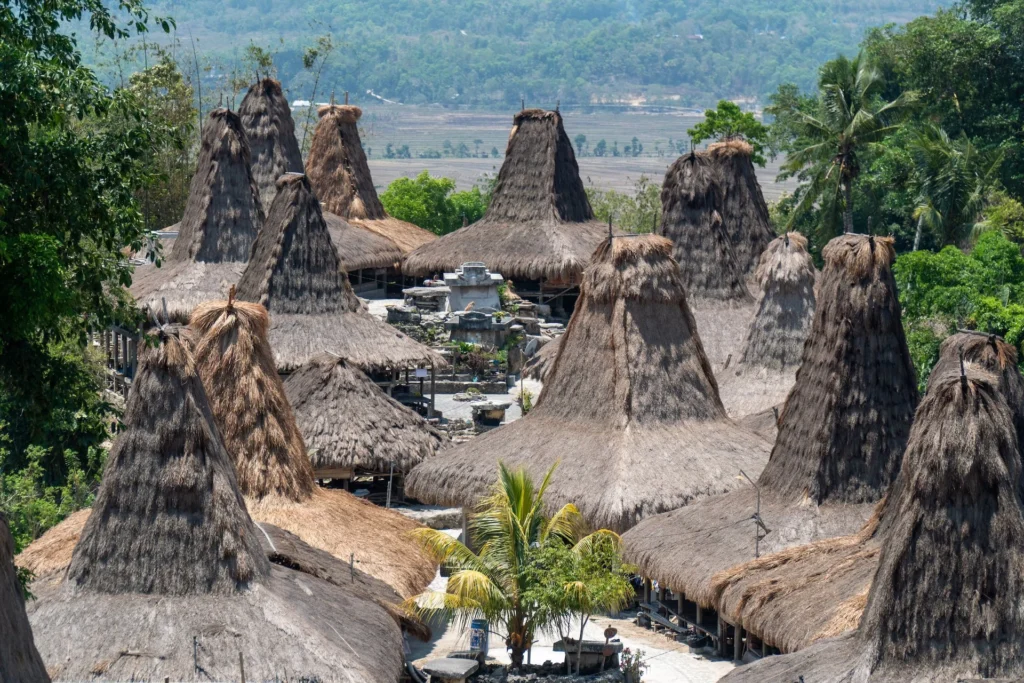
The traditional village cluster around Ratenggaro, Tarung, and Praijing in West Sumba are among the most visually striking and culturally significant sites on the island. Ratenggaro, on the south coast near the mouth of a river, features tall thatched clan houses backed by megalithic tombs directly on the beach, creating one of the most photographed scenes in Sumba. Tarung and Praijing are hilltop villages above Waikabubak with active Marapu ceremonial traditions.
Visits to traditional villages should be approached respectfully. Dress modestly, ask for permission before entering or photographing, and accept any offer of guidance from community members. Many villages have a small entrance donation that supports community maintenance of the site.
Weekuri Lagoon
Weekuri is a saltwater lagoon separated from the ocean by a thin strip of limestone rock, located on the south-west coast near the village of Pero. The water inside the lagoon is calm, clear, and a vivid turquoise colour. Swimming in Weekuri is one of the most reliably enjoyable activities on the island, suitable for non-swimmers and swimmers alike. The best time to visit is in the morning before the light shifts and any other visitors arrive.
Ikat weaving villages
Sumba’s hand-woven ikat textiles are among the most complex and beautiful in Indonesia. The weaving process involves dyeing threads with natural plant-based dyes before weaving, producing patterns of deep burgundy, indigo, cream, and black that can take months to complete. East Sumba has the highest concentration of weaving villages, but ikat is produced throughout the island.
Buying directly from a weaver or a village cooperative ensures that the economic benefit goes to the artisan rather than to an intermediary. Be aware that genuinely hand-made, naturally dyed ikat takes considerable time to produce and is priced accordingly. Suspiciously cheap “Sumba ikat” in tourist markets is often machine-produced or synthetic-dyed.
Pasola festival
The Pasola is a ritual spear-jousting festival that takes place in West Sumba between January and March each year. Two teams of horsemen charge at each other across a field, throwing blunted wooden spears. The ritual is connected to the Marapu belief system and is timed to the appearance of the Nyale sea worms at the full moon, which signals the beginning of the planting season.
Pasola is not a staged event for tourists. It is a living ceremonial practice with deep spiritual significance for the Sumbanese communities that practise it. Visitors are welcome but are expected to observe from the designated areas and to conduct themselves with appropriate respect. The combination of thousands of local spectators, the noise, the colour, and the genuine energy of the ritual makes Pasola one of the most memorable experiences available anywhere in Indonesia.
Horseback riding in the savanna
The Sumbanese horse is a distinctive and celebrated breed: small, sturdy, fast, and deeply connected to the culture and history of the island. Riding through the savanna landscape of West Sumba on a local horse is one of those experiences that is genuinely specific to this place. Several operators offer guided rides through the hills and valleys around the south-west coast.
Practical Information for Visiting Sumba
Currency and payments
The Indonesian Rupiah (IDR) is the only currency accepted across Sumba. Cash is essential, particularly outside the main towns of Waikabubak (West Sumba) and Waingapu (East Sumba). ATMs are available in both towns but are not always reliable in terms of cash availability and connection. Carrying sufficient cash from Bali or withdrawing in Waikabubak or Waingapu before heading to more remote areas is strongly recommended.
Credit and debit card payments are not widely accepted outside of the larger resort properties. Sumba Retreat accepts card payments but always confirm payment options before arrival at any property.
Language
The official language of Indonesia is Bahasa Indonesia, which is spoken and understood across Sumba. In more remote villages and rural areas, the primary language is one of the Sumbanese regional languages, of which there are several distinct dialects across the island. English is spoken to a functional level by staff at the main tourist-facing properties but is much less common outside of those contexts.
Learning a handful of Bahasa Indonesia phrases before your trip is straightforward and will be appreciated everywhere you go. Basic greetings, thank you, please, and numbers are enough to navigate most interactions outside of your accommodation.
Mobile data and connectivity
Mobile data coverage across Sumba is improving but remains patchy and inconsistent outside of the main towns. The main Indonesian mobile operators (Telkomsel has the broadest coverage) provide service in Waikabubak and Waingapu and along major roads, but coverage in more remote coastal areas like Kerewe Beach is limited.
This is worth planning for. Download offline maps (Google Maps and Maps.me both allow this), save important contact numbers and addresses in a format that does not require data, and set expectations with anyone at home who will want to be in regular contact. The connectivity limitations at Kerewe are not a problem for most guests: they are part of what makes it feel remote. But arriving without a plan for this will cause unnecessary stress.
Health and medical
Sumba is a malaria-affected area in parts of the island. Consult a travel medicine clinic before your trip to discuss anti-malarial prophylaxis appropriate for your travel plans and personal health profile. Use DEET-based insect repellent, particularly at dawn and dusk, and sleep under a mosquito net where one is provided.
The nearest hospital with meaningful facilities is in Waikabubak for the west of the island and Waingapu for the east. For serious medical situations, evacuation to Bali would be necessary. Comprehensive travel insurance that covers medical evacuation is not optional for a trip to Sumba: it is essential.
Bring a personal first aid kit that includes antiseptic suitable for reef cuts (coral wounds infect quickly in tropical environments), anti-diarrhoeal medication, rehydration sachets, antihistamines, and any prescription medications you require. Pharmacy options outside the main towns are limited.
Dress and cultural respect
Sumba is a conservative island by Indonesian standards in terms of community expectations around dress and behaviour, particularly in rural and village settings. Covering shoulders and knees when visiting traditional villages or ceremonial sites is both respectful and expected. Swimwear is appropriate on the beach but not in towns or villages.
Sumbanese communities are generally warm and welcoming to respectful visitors. The key word is respectful: listening more than directing, asking before photographing, accepting invitations to share food or sit with community members, and conducting yourself with patience and humility will open doors that assertive or entitled behaviour will firmly close.
Budgeting for a Sumba Trip
Sumba covers a wide range of budget levels, from very basic guesthouses at the lower end to ultra-luxury properties like Nihi Sumba Resort at the higher end. Understanding where different types of accommodation and experiences sit will help you plan a realistic budget.
Budget end: Basic losmen (guesthouses) in the main towns of Waikabubak and Waingapu and in some coastal villages around well-visited areas. Food at local warungs is inexpensive. Transport costs are the biggest variable at the budget level, as hiring a driver for the day adds up. A budget traveller with their own transport and flexible eating habits can visit Sumba affordably, but comfort levels are basic.
Mid-range: Small retreats and boutique guesthouses with better facilities, private bathrooms, and more reliable service. This is where Sumba Retreat Kerewe sits: genuine character, good food, direct beach access, and a level of comfort that makes a week-long stay genuinely relaxing rather than merely adequate. Costs at the mid-range level reflect the logistics of operating a quality property in a remote location.
Luxury end: Nihi Sumba Resort operates at the very top of the global luxury resort market, with pricing to match. It represents a specific and exceptional experience for those with the budget for it, but it is not the right context for most visiting surfers or independent travellers.
Flights from Bali, ground transfers, accommodation, food, activities, and any surf charters should all be factored into your trip budget. Sumba is not cheap in the way that budget backpacker destinations in Southeast Asia can be, particularly if you are staying somewhere with genuine quality and direct beach access. But it offers extraordinary value in terms of the experience you receive for the price, particularly relative to equivalent-quality accommodation in Bali or Lombok.
Where to Stay in West Sumba
For visitors whose itinerary centres on the south-west coast, the surf breaks, the beaches, and the traditional villages of West Sumba, the right base is an accommodation that puts you directly in the landscape rather than requiring daily transport to reach the places you came to see.
Sumba Retreat Kerewe is located directly on Kerewe Beach in the Lamboya district of West Sumba, roughly 70 kilometres south of Tambolaka Airport. The retreat offers traditional Sumbanese-style bungalows and villas built from local bamboo and natural materials, with a direct view of the surf break from the accommodation. It is an eco retreat with a genuine commitment to local community employment, sustainable building practices, and low-impact tourism, described in more detail in the eco retreat guide.
The location is the strongest practical argument for staying at Sumba Retreat. With the beach and the surf immediately in front of the accommodation, the experience of being in Sumba intensifies: morning sessions before the wind picks up, afternoons exploring the coast, evenings watching the sun set over the water from the veranda. The whole rhythm of the day is shaped by the beach rather than by the logistics of getting to it.
Start Planning Your Sumba Trip
The most common thing that first-time visitors to Sumba say after they leave is that they wish they had come sooner and stayed longer. The island has a way of expanding your sense of what Indonesian travel can be: slower, deeper, more connected to the landscape and the people who live in it, and genuinely surprising in ways that more visited destinations rarely manage anymore.
The window to experience Sumba at this level of authenticity and quietness is still open. It will not be open indefinitely. The travellers who come now are seeing the island at a moment that future visitors will read about and wish they had been part of.
Check availability and book your stay at Sumba Retreat Kerewe for the best-positioned base on the south-west coast. For questions about transfers from Tambolaka, surf conditions, or what to expect on arrival, contact the retreat team on WhatsApp at +62 853 3923 4685 or email info@sumbaretreat.com.
For more on specific topics covered in this guide, explore the related articles below:
- The Ultimate Guide to Surfing in Sumba, Indonesia
- Kerewe Beach Surf Guide: Sumba’s Best Uncrowded Wave
- What Makes a Truly Eco-Friendly Retreat? Lessons from Sumba Island
Sumba Retreat Kerewe is located on Kerewe Beach (Pantai Kerewei), Lamboya district, West Sumba, East Nusa Tenggara, Indonesia.